







When part of a tooth cracks or breaks, patients often ask me whether it can be repaired with a filling or if it now requires a dental crown.
In my practice, the decision almost always comes down to one core clinical question:
Is there enough strong, natural tooth structure left to reliably hold a filling, or does the remaining tooth need broader structural protection?
This is how I help the patient understand the assessment:
“A filling replaces a localised missing section. A dental crown is considered when the remaining tooth structure needs to be bound together and shielded from everyday chewing forces.”
If you’ve cracked or broken a tooth and are weighing up a dental filling versus a dental crown in Sydney, an assessment is the best way to find out what your tooth actually needs.
Crown vs. Filling: Understanding the Main Difference
A filling repairs a specific, isolated section of a tooth. It generally works best when the surrounding natural tooth remains strong enough to support the restoration and withstand normal biting pressure. Fillings can wear, chip or crack over time, particularly when exposed to ongoing heavy pressure.¹
A dental crown, sometimes called a cap, covers the visible portion of a damaged tooth above the gum line.² Rather than simply replacing the part that has been lost, a crown provides wider coverage around the remaining tooth.
That distinction is important because replacing a missing tooth and protecting weakened tooth structure are not always the same thing.
A filling may be suitable when the remaining tooth can continue doing most of the structural work itself. A crown may be considered when broader coverage of the remaining tooth structure is clinically appropriate.
How I Decide Between a Filling and a Crown
Rather than looking at the size of the broken area alone, I assess the tooth as a whole. There are four main things I consider.
1. How much of a healthy tooth is left?
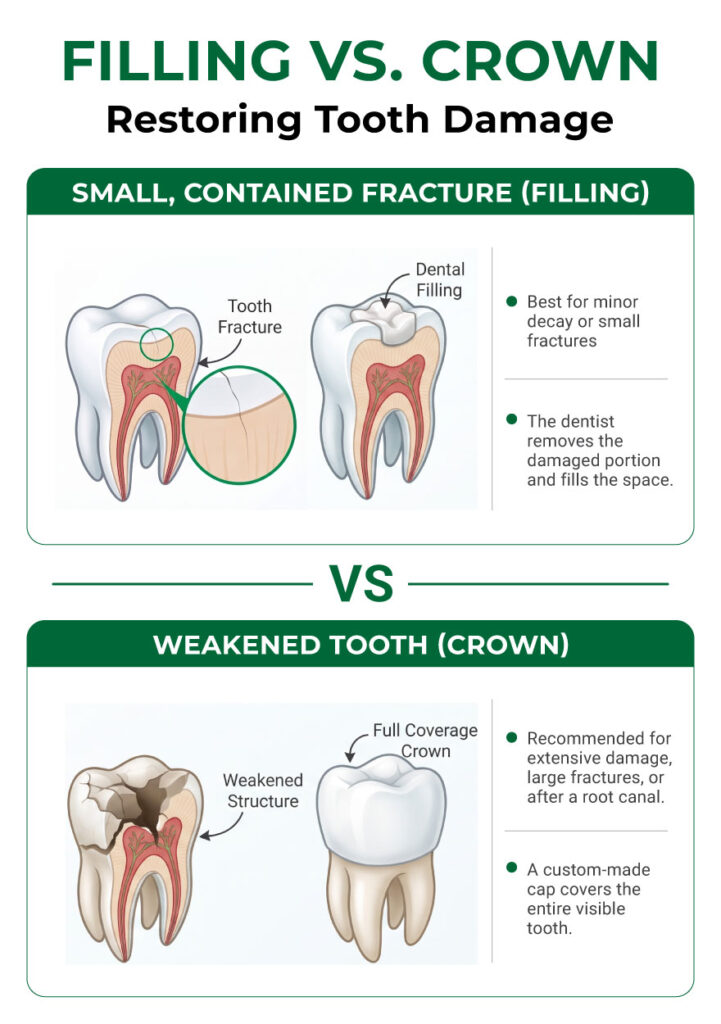
When only a small, contained area has been damaged and most of the natural tooth remains sound, a filling may be the more conservative option.
As more tooth structure is lost, however, the restoration itself needs to replace a larger proportion of the tooth. At some point, the remaining natural structure may no longer provide enough reliable support for another filling.
2. How much of a healthy tooth is left?
The raised points on your back teeth are called cusps. They carry much of the pressure created when you chew.
If these remain strong and well supported, a filling may still be suitable.
When a crack or fracture has weakened a cusp, broader coverage may be required because repairing only the missing section can leave the remaining cusp vulnerable to further fracture. Clinical guidance supports the use of cusp-protecting restorations where appropriate.³
In selected cases, I may also discuss an onlay, which can cover one or more weakened cusps while preserving more natural tooth structure than a full crown.
3. Are the remaining tooth walls strong enough?
A tooth can sometimes look as though it only needs a small repair while the natural tooth surrounding that area has already become thin or unsupported.
This is particularly relevant when the tooth has previously had a large restoration.
The question is therefore not simply, “Can I put a filling here?” It is also:
“Will the tooth surrounding that filling remain strong enough under repeated chewing pressure?”
4. How much pressure does this tooth carry?
The same amount of damage may affect two teeth differently.
I consider where the damage is located, the condition of the remaining tooth, the patient’s bite and the forces the tooth is likely to experience during normal use.
“I never decide based on the size of the hole alone. I look at how much strong tooth is left, where it is positioned and how much biting pressure it carries day to day.”
When May a Filling Be Enough?
A filling may be suitable when the damage is relatively small and the tooth still has a strong natural foundation.
For example, I may consider a filling when:
- only a small portion of the tooth has been lost
- the surrounding enamel and dentine remain healthy
- the main chewing cusps remain supported
- the remaining tooth can safely support the restoration.
The aim is always to preserve healthy natural tooth structure where clinically appropriate.
“When we have plenty of strong, healthy tooth surrounding the damage, a filling is often the more conservative choice.”
When May a Dental Crown Be Considered Instead?
A dental crown may be considered when the assessment shows that the issue is no longer just the missing section of tooth.
The remaining tooth may need broader protection because of substantial structural loss, a weakened chewing cusp, thin supporting walls or a large existing restoration.
At that point, simply making the filling larger may not address the underlying structural problem.
The appropriate treatment still depends on the location and extent of the damage and the health of the remaining tooth.³
How Does a Crown Protect a Cracked Tooth?
A dental crown provides coverage around the remaining natural tooth.
For an appropriately selected tooth, crown coverage may help:
- reduce movement or flexing of weakened tooth structure during chewing
- distribute chewing forces across the restored tooth
- provide coverage for weakened sections of the tooth
- restore the tooth’s shape and chewing surface.
A crown does not heal a crack or guarantee that a tooth will never experience another problem. The outcome depends on factors including the depth and position of the crack and the health of the underlying tooth.
For more information about how crowns are fitted, see our Dental Crown Procedure guide.
What If the Tooth Already Has a Large Filling?
This is a common situation and deserves a slightly different conversation.
Fillings can wear, chip or crack with time. There may also be decay around or underneath an existing restoration.
When I assess a tooth with an older or very large filling, I am not recommending a crown simply because a filling is old. Instead, I assess what condition the tooth is now in.
If the filling remains stable and the surrounding tooth is healthy and well supported, replacement may not be necessary.
If the tooth has become structurally compromised, however, we then return to the same question that guides the rest of the decision:
Is there enough strong natural tooth remaining to reliably support another filling?
What About Older Amalgam Fillings?
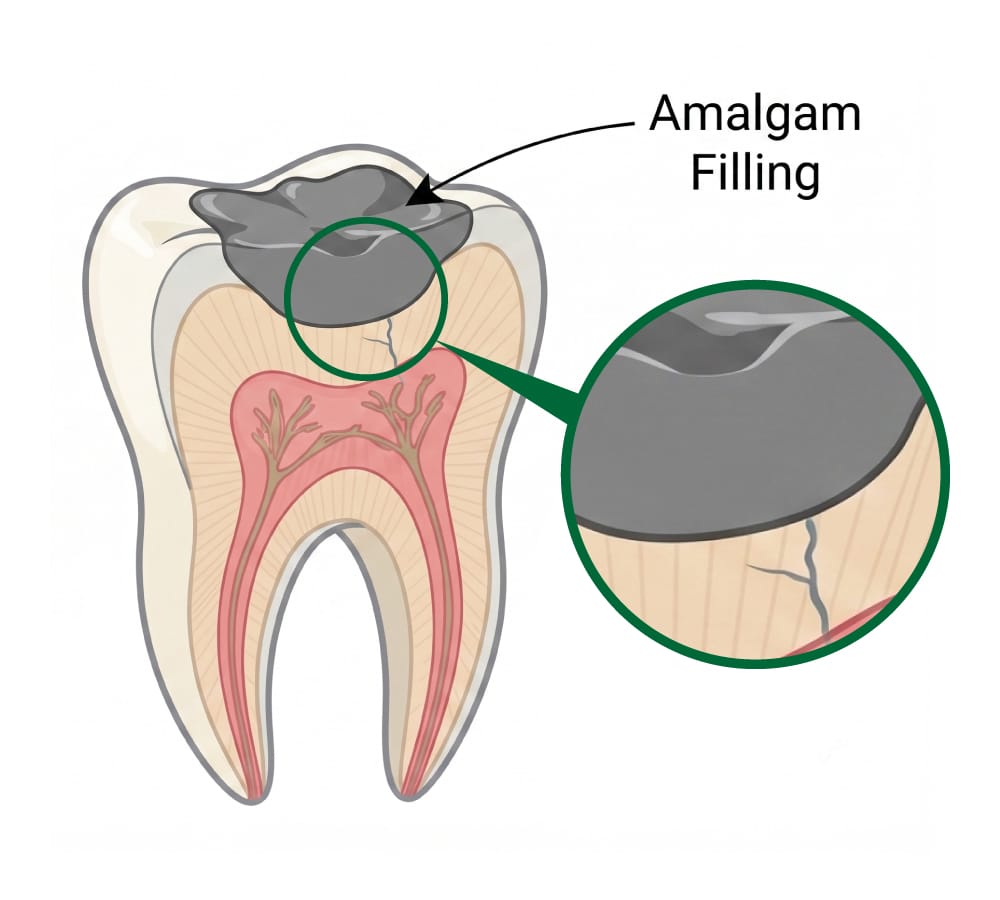
Amalgam is a clinically well-established restorative material,⁴ and a stable amalgam filling does not need to be replaced simply because it is metal.
What matters is the condition of the filling and the tooth around it.
If an older amalgam restoration is still functioning well and the surrounding tooth remains sound, I may recommend monitoring it.
If there is deterioration, decay or structural damage, I will assess whether another filling, an onlay or a crown is appropriate.
“The presence of an old metal filling alone is not a reason to recommend a crown. I assess the filling, the remaining tooth structure and whether the tooth is still properly supported.”
Common Questions About Broken Teeth and Crowns
Is a “tooth cap” different from a crown?
No. A tooth cap and a dental crown refer to the same type of restoration. “Cap” is the everyday term, while “crown” is the clinical term commonly used by dentists.
Can you put a crown on a broken tooth?
Often, yes — provided the tooth has enough healthy and stable structure to support the restoration.
A crown may be less suitable when the damage extends too far beneath the gum or there is insufficient sound tooth structure remaining.⁵
Your dentist will also assess the root, supporting tissues and whether the tooth can be properly restored and maintained.
Is it worth crowning a cracked tooth?
For an appropriate, restorable tooth, a crown may provide useful structural protection when a filling would leave weakened sections of the tooth unsupported.
Whether it is worthwhile depends on the individual tooth, including the location and extent of the crack and the condition of its foundation.
What should you do if half your tooth breaks off?
Arrange a dental assessment so the extent of the damage can be checked. Until then, avoiding chewing on the affected tooth may help reduce further stress on it.
Losing a substantial part of a tooth does not automatically mean you will need a crown, but the amount of remaining healthy structure becomes particularly important.
Your dentist can determine whether the tooth is suitable for a filling, onlay, crown or another treatment.
When is a tooth not suitable for a crown?
A crown requires a suitable foundation.
It may not be appropriate when:
- there is insufficient healthy tooth structure to support the restoration
- damage extends into an area that cannot be predictably restored or sealed
- the root or supporting tissues have a poor outlook
- the restored tooth could not be adequately maintained.
If a crown is not suitable, your dentist can discuss other treatment options.
Summary: Dental Crown vs Filling
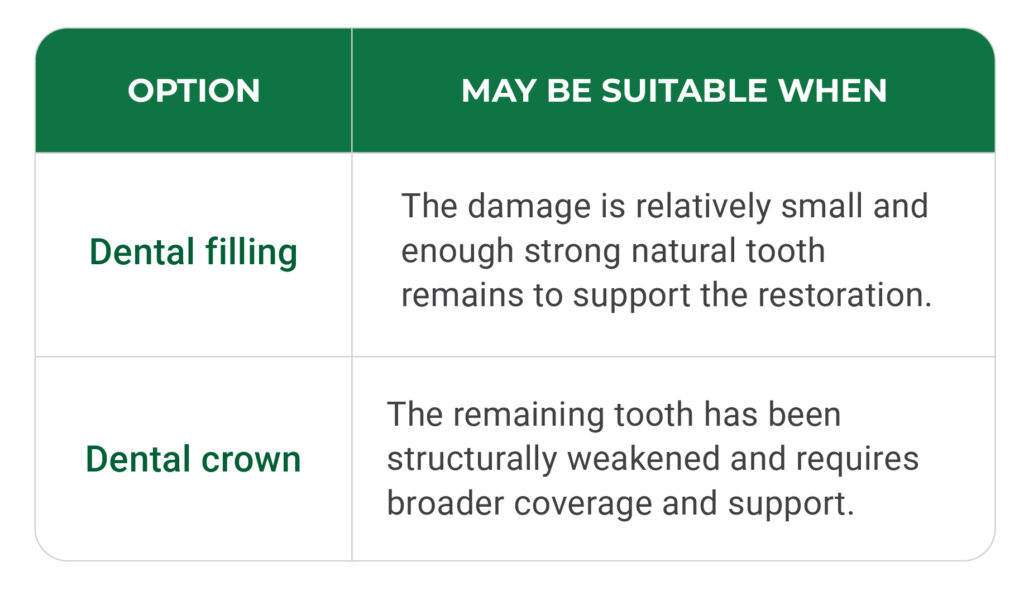
The important point is that the decision is based on the strength of the tooth that remains, not simply the size of the visible break.
“The best restoration is the one that protects the tooth without removing more healthy structure than necessary.”

Have Your Broken Tooth Assessed at No Gaps Dental Brookvale
If you have cracked a tooth, broken part of a filling or lost a substantial section of tooth structure, book an assessment with me or the team at No Gaps Dental Castle Hill, Cherrybrook or Brookvale.
Not close to any of these? No Gaps Dental has 18 clinics across Sydney, so you can find a dentist in Sydney near where you live or work.
We can assess how much healthy tooth remains and explain whether a filling, onlay or crown may be suitable for your individual tooth.
General information only. Whether a filling, onlay, dental crown or another treatment is appropriate depends on the condition of the individual tooth. A dental examination is required before treatment can be recommended. Dental treatments have potential risks and limitations, which your dentist can discuss with you as part of the assessment and consent process.
Sources & References
- Healthdirect Australia — Dental fillings
- Healthdirect Australia — Dental crown procedure
- American Association of Endodontists – Cracking the Cracked Tooth Code: Detection and Treatment of Various Longitudinal Tooth Fractures.
- Australian Dental Association — Policy Statement 6.18: Safety of Dental Amalgam
- National Health Service (NHS) — Chipped, broken or cracked tooth
Important Information
All dental treatments have potential risks and limitations. A clinical assessment is required to determine which treatment is suitable for your individual circumstances.
Any surgical or invasive procedure carries risks. Before proceeding, you should seek a second opinion from an appropriately qualified health practitioner.
This article is written by Dr Than Lwin Ye Myint of No Gaps Dental Castle Hill, Cherrybrook, and Brookvale clinics.