





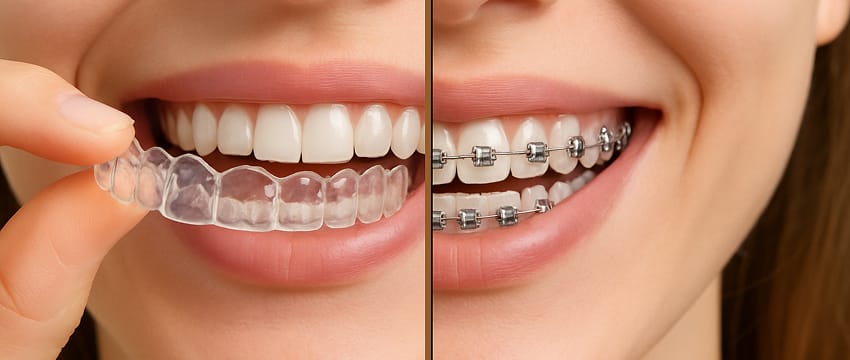
Are you considering orthodontic treatment but unsure whether clear aligners or traditional braces are the right option? Both treatments can help straighten your teeth and improve your smile. However, the ideal choice depends on your dental needs, lifestyle, and budget. In this guide, we’ll break down the key differences, benefits, and considerations to help you decide with confidence.
What Are Clear Aligners?
Clear aligners are a discreet and modern alternative to braces, designed to straighten teeth without the use of metal wires or brackets. Made from smooth, transparent plastic, these custom-moulded trays fit snugly over your teeth and are virtually invisible when worn, making them a popular choice for adults and teens who want a less noticeable treatment. Aligners work by gently applying controlled pressure to move your teeth into alignment, all under the supervision of your orthodontist. Their removability offers flexibility for eating, brushing, and special occasions, making them a convenient solution for many everyday lifestyles.
They’re customised, transparent plastic trays that fit snugly over your teeth.
- How they work: You’ll receive a series of aligners, each worn for around 10–14 days. They apply gentle, consistent pressure to shift your teeth into position. Small, tooth-coloured attachments may be added to assist movement.
- Brands: Leading brands like Invisalign and ClearCorrect use advanced 3D imaging to create precise, custom-fit trays.
- Ideal candidates: Clear aligners suit adults and teenagers who want a less noticeable option. They’re most effective for mild to moderate alignment issues like spacing or minor bite irregularities. Consistent wear (20–22 hours daily) is essential for success.
What Are Traditional Braces?
Traditional braces have long been a reliable and versatile method for correcting dental misalignments. They use a system of brackets, wires, and bands to apply steady pressure that gradually moves teeth into their ideal positions. Despite the rise in popularity of clear aligners, braces remain a go-to solution, particularly for patients with complex orthodontic needs. Whether you’re dealing with overcrowding, significant bite problems, or rotated teeth, traditional braces offer proven results and precise control guided by your orthodontist.
- Types of braces:
- Metal braces: The most common type, made from durable stainless steel. Brackets are bonded to each tooth and connected by a wire, held in place by elastic bands.
- Ceramic braces: These function like metal braces but use clear or tooth-coloured brackets, offering a more subtle appearance.
- How they work: Brackets are fixed to your teeth, and a wire applies continuous force to move them gradually. Your orthodontist adjusts the wire periodically to guide the movement.
- Ideal candidates: Traditional braces are suitable for patients of all ages and are highly effective in treating complex cases, including severe overcrowding, major bite issues, and significant rotations. Their fixed nature eliminates the need for patient compliance.
Key Differences Between Clear Aligners and Braces
Understanding the main differences between these two treatments can help you make the right decision for your smile.
Appearance
- Clear Aligners: Nearly invisible when worn, making them ideal for those who prefer a subtle option.
- Braces: Metal braces are more noticeable, while ceramic braces are less conspicuous with clear or tooth-coloured brackets.
Comfort & Convenience
- Clear Aligners: Generally cause less irritation due to the smooth plastic design. They’re removable, so you can eat freely and maintain your usual hygiene routine.
- Braces: May cause initial discomfort or irritation to lips and cheeks. Fixed in place, so dietary adjustments are needed to avoid damaging wires or brackets.
Hygiene & Maintenance
- Clear Aligners: Easier to maintain oral hygiene, as trays can be removed for brushing and flossing.
- Braces: Require more effort to clean around brackets and wires. Special tools (like interdental brushes) are often necessary.
Treatment Duration
- Clear Aligners: For simple cases, treatment may be shorter. However, more complex issues may take just as long—or longer—than braces.
- Braces: Typically worn for 18–24 months, depending on the severity of the misalignment.
Cost Comparison
- The overall cost of treatment depends on the case complexity, brand of aligners, and your orthodontist’s fees. Both treatments are often comparable in price, though braces may be slightly more cost-effective in some cases.
Effectiveness for Complex Cases
- Clear Aligners: Excellent for mild to moderate issues. Not always suitable for severe cases.
- Braces: Offer superior control for complex orthodontic needs and are the go-to choice for more significant corrections.
Pros and Cons for Aligners and Braces
Clear aligners and traditional braces can both straighten teeth, but they differ in how they look, feel and fit into daily life.
Clear aligners are nearly invisible and made from smooth plastic, so they tend to cause less irritation. Because they’re removable, you can take them out to eat, brush and floss, which means no food restrictions and easier cleaning. The trade-off is that they only work if you wear them 20 to 22 hours a day. Traditional braces are more noticeable, although ceramic options are less visible than metal. They’re fixed to the teeth, so they can cause some initial discomfort to the lips and cheeks, and you’ll need to take extra care cleaning around the brackets and wires and avoid sticky, hard or chewy foods.
When it comes to results, aligners are effective for many cases but are less suited to complex misalignments, while braces can treat a wide range of cases. Aligners may be quicker for simpler cases, and braces often take around 18 to 24 months, depending on the case. Braces are also less reliant on daily wear since they stay in place, though elastics may still be needed.
Costs are often similar, but aligners can be higher for complex cases or branded systems, and braces can be slightly lower in some cases. Aligners also tend to mean fewer emergency visits, as there are no brackets or wires that can break and need repair.
Which Option Is Right for You?
The ideal orthodontic treatment depends on your unique dental situation, preferences, and lifestyle. Your No Gaps Dental orthodontist will guide you through your options during a personalised consultation.
- Lifestyle considerations: If discretion matters (e.g. for work or social settings), clear aligners are a discreet solution. Prefer to eat freely? Aligners let you do so.
- Patient compliance: Clear aligners require self-discipline. If you’re worried about forgetting to wear them, braces provide consistent correction without effort.
- Budget and insurance: Discuss the costs and your private health cover with our team to understand which option best fits your financial situation.
- Age-specific suitability: Both braces and aligners work for teens and adults. Adults often favour aligners for their subtlety, while braces are ideal for younger patients or complex needs.
Book a Consultation at No Gaps Dental
At No Gaps Dental, we offer both clear aligners and traditional braces to help you achieve a healthier, more confident smile. Our experienced orthodontists will assess your dental alignment and recommend the best treatment plan for your needs and goals.
Don’t wait to take the first step towards a straighter smile.
Book your consultation today and let us help you choose the orthodontic option that’s right for you.