




There are several types of dental implants, and the right one for you will depend on how many teeth you’re missing and the condition of your jawbone.
If you’re considering getting dental implants in Sydney, here’s a straightforward guide to what’s available.
Not sure which option suits you? Book a dental implant consultation at one of our 18 Sydney clinics and our dentists can talk you through your options.
What are dental implants?
A dental implant is a small titanium post inserted into the jawbone to replace a missing tooth root. Over time, it fuses with the bone and provides a stable base for an artificial tooth — whether that’s a crown, bridge, or denture.1
Breaking Down the Different Dental Implant Types
Dental implants differ in two ways: how they anchor in the body, and what they’re used to replace. Here’s a breakdown of both.
Endosteal implants
Endosteal implants are the most common type. A titanium screw is placed directly into the jawbone, where it fuses with the bone over time. Most patients are suitable candidates, as long as there’s enough healthy jawbone to support the implant. If bone density is low, a bone grafting procedure may be needed first.
Most implant-based restorations — single crowns, bridges, and full-arch solutions — fall under this category.
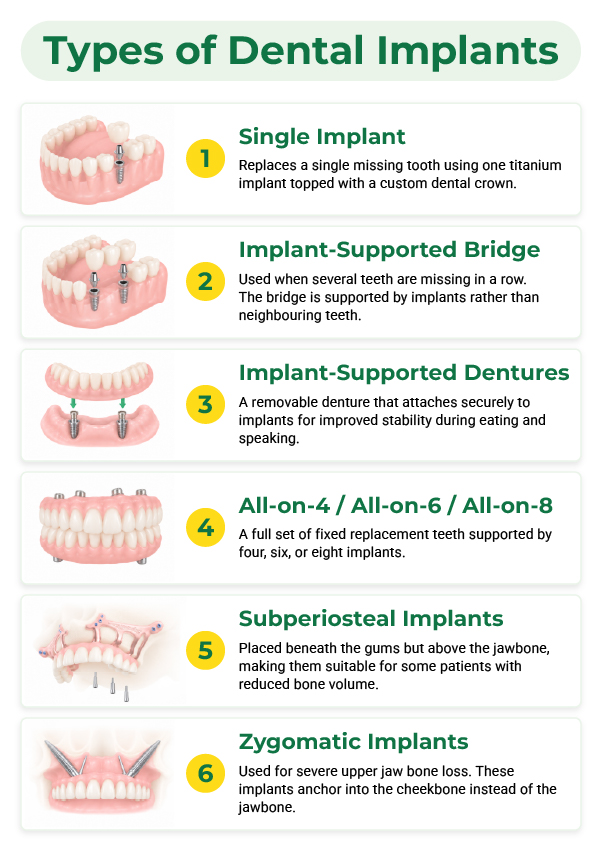
Single implant
A single implant replaces one missing tooth. One post is placed in the jaw and topped with a custom dental crown matched to your surrounding teeth.
Implant-supported bridge
If you’re missing several teeth in a row, an implant-supported bridge may be recommended.
Rather than relying on healthy neighbouring teeth for support, the dental bridge is anchored directly to implants.
This can make it a viable option even when adjacent teeth aren’t strong enough to support a traditional dental bridge.
As a general guide, two dental implants can support three adjacent teeth, and four implants can support five. Implant-supported bridges may also help slow the bone loss that tends to occur where teeth are missing. See our guide on the benefits of dental implants for more detail.
Implant-supported dentures (overdentures)
If you’ve lost most or all of your teeth in one arch, implant-supported dentures may be an option.
These attach directly to implants rather than relying on suction or adhesive, which can improve stability during eating and speaking.
Overdentures are removable, and they snap onto the implants and can be taken out for cleaning.
All-on-4, All-on-6 and All-on-8 Dental Implants
A fixed full-arch alternative to removable dentures. A complete set of teeth is supported by four, six, or eight implants that are permanently attached and only removable by your dentist.
The number of implants used depends on your bone density, jaw structure, and the load the restoration needs to bear.
All-on-X options are often considered where bone levels aren’t sufficient for a full set of individual implants.
Subperiosteal implants
Subperiosteal implants sit under the gum but on top of the jawbone, rather than inside it. A metal framework is placed on the bone and the gum heals around it to hold it in place. Replacement teeth attach to posts that protrude above the gumline.
This type doesn’t require bone depth, so it may be worth discussing with your dentist if bone loss has ruled out conventional implants — without the need for bone grafting.
The trade-off is less biting strength compared to endosteal implants.
Zygomatic implants
Zygomatic implants are used when jawbone loss is so severe that other implant types may not be viable.
Instead of anchoring into the jaw, they fix into the cheekbone, which tends to hold its density even after significant bone deterioration.
These are longer than standard implants and require specialist surgical expertise — so they’re not available at every clinic.
If you’ve previously been told implants aren’t possible due to bone loss, it may be worth asking a specialist whether zygomatic implants could be an option.
For more on expected outcomes across different implant types, see our guide on how long dental implants last.
Once you know which type suits your situation, our dental implant procedure guide walks you through what to expect at each stage.
The best way to find out which type may suit you is a clinical assessment. Book an appointment and one of our dentists in Sydney can check your jawbone and gum health, and explain the options available to you.
Who is Not Suitable for Dental Implants?
Most patients need to meet certain requirements before dental implants can go ahead. A medical assessment and examination of your jaw will be carried out beforehand.
Medical Conditions
Certain long-term conditions (such as auto-immune disease, blood-clotting disorders, or diabetes) may affect suitability.2 If these are well-controlled, dental implants may still be possible, but this is assessed on a case-by-case basis.
Bone Loss
Bone loss in the jaw is one of the most common barriers to dental implants. Without enough bone to anchor the dental implant, the procedure can’t go ahead without preparation.1
In many cases, a bone graft is carried out first to build up the jawbone, which can affect both the timeline and overall dental implants cost.
Smokers
Smoking can impair the healing process and reduce blood flow to the surgical site, which is why dental implant success rates tend to be lower in smokers.2
Research suggests the failure rate is considerably higher compared to non-smokers. One study of several thousand implants found a failure rate of 5.6% among current smokers, compared with 3.5% among non-smokers.3
The Takeaway
There are several types of dental implants, from single tooth replacements to full-arch treatment, and the right option will depend on your individual situation.
Book a consultation with one of our dentists in Sydney across 18 locations to see if dental implants are suitable for you.
Important Information
All dental treatments have potential risks and limitations. A clinical assessment is required to determine which treatment is suitable for your individual circumstances.
Any surgical or invasive procedure carries risks. Before proceeding, you should seek a second opinion from an appropriately qualified health practitioner.
Sources & References