




Dental implants are tooth replacement options that have revolutionised modern dentistry; they are fixed in place and designed to look and function like natural teeth.
There are multiple factors that affect a dental implant’s longevity, including the implant’s quality, the skill of your dentist, your overall health, the implant placement, and your routine oral care.
Here’s what you need to know before getting dental implants in Sydney.
If you’re weighing up implants now, you can get advice based on your own situation when you book an dental implant consultation.
How Long Do Dental Implants Last?
The short answer is that dental implants (the titanium screws that fuse with your jawbone) are designed to be a long-term solution.
Many implants last between 10 and 20 years, and some last considerably longer with good care. A 2019 systematic review of long-term studies found that around 93–96% of implants were still in place after 10 years.1
The visible part of the system, the dental crown, is a different story, and it typically needs replacing every 5 to 15 years. “I explain to patients that the implant and the crown age differently,” says Dr Sonali. “The dental implant sits in the bone, while the crown does the chewing every day, so it is the crown we expect to maintain or replace over time.”
Your dentist will have the knowledge of your specific situation to give you a more personalised answer, along with tailored advice on caring for your dental implants.
Tooth Replacement Options
Previously, a patient’s missing tooth replacement options consisted only of dental bridges and dentures.
Dentures are removable and need daily cleaning and periodic adjustment, while dental bridges can last up to 15 years.
Dental implants are fixed in the jawbone and, with good care, can last for many years. Each option has benefits and limitations, which your dentist can talk you through.
The Components of a Dental Implant
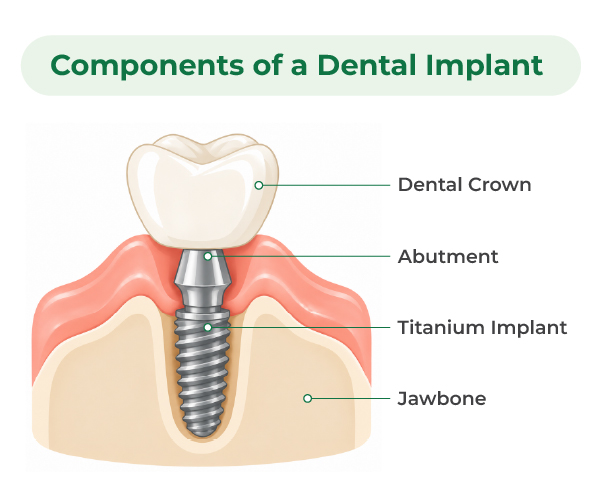
A dental implant is a complete tooth replacement system made up of three components:
- A titanium implant
A small post secured into the jawbone in place of the old tooth root. Titanium is used because it is bio-compatible and highly resistant to corrosion. After surgery, it fuses with the surrounding bone through a process called osseointegration, giving the implant its long-term stability. To learn more about how this works, see our guide to the dental implant procedure. - An abutment
Screws into the implant base and connects it to the crown, sitting just above the gum line. - A dental crown
The only visible part of the implant. Crafted from resin, porcelain, ceramic, metal, or porcelain fused to metal to mimic a natural tooth. Most dental crowns last 5 to 15 years, though some last longer with good oral hygiene and regular check-ups.
Factors Impacting the Lifespan of your Dental Implants
Several factors influence how long your dental implants last, starting before surgery even takes place.
How you use your teeth
Chewing ice, biting hard objects, and grinding your teeth all accelerate crown wear. Contact sports carry an impact risk too. These habits damage crowns but are unlikely to harm the titanium post itself.
The placement within your mouth
Dental implants at the back of the mouth bear more chewing force than those at the front, meaning the dental crown experiences more wear and may need replacing sooner.
Your oral and overall health
Dental implants require sufficient healthy jawbone to anchor properly, and patients with significant bone loss may need additional treatment before surgery can proceed. Any active gum disease should also be resolved beforehand, as implants placed into an unhealthy mouth are far more likely to fail.2
Once in place, poor gum health remains a risk.
Left unchecked, it can develop into peri-implantitis, which is an infection of the tissue surrounding the implant that causes bone loss and, if untreated, implant failure. Implants can’t get cavities, but they are not immune to gum disease. One systematic review estimated that around one in five implant patients develop peri-implantitis.3
Patients with chronic conditions such as diabetes, rheumatoid arthritis, or osteoporosis also face a higher risk of complications. Those with diabetes in particular should keep blood sugar levels well managed, as elevated levels increase susceptibility to gum disease and implant failure.
If you have an existing health condition, your dentist and GP will monitor you closely around surgery.
Not sure whether your gums and jawbone are ready for an implant? One of our dentists in Sydney can assess your suitability and talk you through your options, so book a consultation.
Diet and lifestyle choices
Smoking is one of the most significant risk factors for dental implant failure as it reduces blood flow to the gums, impairing healing and osseointegration. Some dentists will not place dental implants in active smokers for this reason. One review found that dental implants placed in smokers were around twice as likely to fail as those placed in non-smokers.4
Heavy drinking and a diet high in sugar or refined carbohydrates encourages bacterial growth and plaque accumulation, both of which put your dental implants at risk over time.
For a broader look at whether dental implants are right for you, see our guide to the pros and cons of dental implants.
Caring for a Dental Implant
Good oral hygiene is one of the most important parts of dental implants aftercare.
Follow your dentist’s hygiene advice before and after surgery to support healing. “Cleaning around an implant takes a little more care than a natural tooth,” says Dr Sonali, “so I always show patients where to angle the brush and how to use interdental brushes at the gumline.”
Once the site has healed, brush at least twice a day using a fluoride toothpaste, and floss daily.2
Left unchecked, plaque hardens into tartar, irritates the gums, and can eventually cause peri-implantitis, which is a common dental implant problems.
Replacing the Crown on your Dental Implant
Over time, you may notice some telltale signs that your dental crown must be replaced. These signs include discolouration of the crown or surrounding teeth, chipping and wear.
Regular dental check-ups to the dentist can keep you alerted of any changes to your dental crown that need to be addressed.
Dental implants are a long-term investment in your oral health, but dental crowns don’t last forever.
When you work with a qualified dental practice and maintain healthy habits, you give your dental implants the best chance of lasting for many years.
At No Gaps Dental, our dentists in Sydney have years of experience in helping patients maintain the health of their smile through dental implant surgery.
Frequently Asked Questions
Can a dental implant last a lifetime?
Some dental implants stay in place for decades, but no dentist can guarantee how long an individual implant will last. Your bone and gum health, habits such as smoking or grinding, and how well the implant is maintained all play a part. The crown on top will usually need replacing at some stage.
Can a failed dental implant be replaced?
In some cases, yes. Your dentist will first work out why the implant failed, treat any infection and check whether enough healthy bone remains. If bone has been lost, bone grafting for dental implants may be needed before a new implant can be placed.
What are the signs of a problem with my implant?
See your dentist if you notice bleeding or swelling around the dental implant, pain, a bad taste, or if the implant or crown feels loose. Problems such as peri-implantitis are easier to manage when they are picked up early.
How often should I see the dentist after getting an implant?
Your dentist will recommend a schedule based on your oral health. Many patients with implants have a dental check-up and professional clean every six to 12 months, so any changes around the implant can be picked up early.
Book an Implant Consultation in Beverly Hills or Epping
If you are considering dental implants in Sydney, book a consultation with me or the team at No Gaps Dental Beverly Hills or Epping. Not close to either of these? No Gaps Dental has 18 clinics across Sydney. Call (02) 8007 6727 or book an appointment online.
Important Information
All dental treatments have potential risks and limitations. A clinical assessment is required to determine which treatment is suitable for your individual circumstances.
Any surgical or invasive procedure carries risks. Before proceeding, you should seek a second opinion from an appropriately qualified health practitioner.
Sources & References
- Howe M-S, Keys W, Richards D. Long-term (10-year) dental implant survival: a systematic review and sensitivity meta-analysis. Journal of Dentistry. 2019;84:9–21. https://livrepository.liverpool.ac.uk/3041376/
- Australian Dental Association. Dental implants. Teeth.org.au. https://www.teeth.org.au/dental-implants
- Derks J, Tomasi C. Peri-implant health and disease: a systematic review of current epidemiology. Journal of Clinical Periodontology. 2015;42(Suppl 16):S158–S171. https://doi.org/10.1111/jcpe.12334
- Mustapha AD, Salame Z, Chrcanovic BR. Smoking and dental implants: a systematic review and meta-analysis. Medicina. 2021;58(1):39. https://pmc.ncbi.nlm.nih.gov/articles/PMC8780868/
This article is written by Dr Sonali Arora of No Gaps Dental Beverly Hills and Epping clinics.